


Becoming the Ocean: Letting Go of Who We Say We Are
Updated: Mar 3
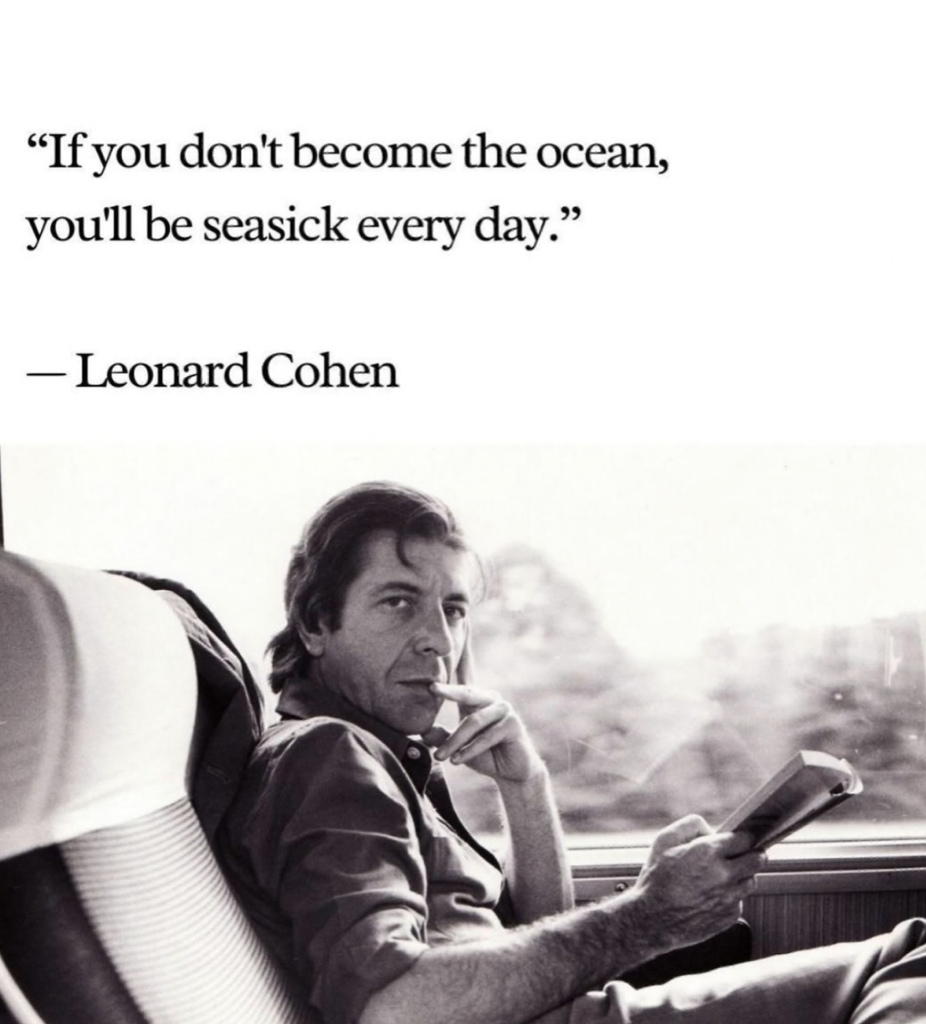
"If you don't become the ocean, you'll be seasick everyday."
— Leonard Cohen
There is something about this killer line that lands quietly and then keeps unfolding when I listen to it . It speaks to the human tendency to hold on tightly — to identities, roles, beliefs, and stories about who we are and how life should be. And it speaks to the cost of that holding.
In therapy, I often meet people at the point where the holding has become exhausting.
They are trying very hard to be a certain version of themselves:the strong one, the good one, the successful one, the thin one, the calm one, the one who copes.
Yet inside, something feels unsettled — a kind of emotional seasickness.
Fixity: The Safety of Certainty
Fixity can feel safe. Labels, narratives, and long-held beliefs give us a sense of structure:
“I am an anxious person.”
“I always mess things up.”
“I have to be in control.”
“This is just who I am.”
These statements can begin as attempts to make sense of our experience. Over time, though, they can harden into identities. What once helped us survive starts to limit how we live.
There is also another, quieter cost.When we become preoccupied with finding the right label, the right explanation, the right diagnostic language, we can inadvertently move away from the immediacy of our lived experience. We start thinking about ourselves rather than being ourselves.
In those moments, we risk missing the subtle, felt sense of who we are — the parts that don’t fit the label, the feelings that contradict the story, the aliveness that cannot be categorised.
In person-centred and pluralistic therapy, we don’t try to rip these beliefs away. They often formed for good reasons. They protected us. They helped us belong. They made the world more predictable.
But when they become rigid, they reduce our range of movement. We stop being a person having anxiety and start being an anxious person. We stop noticing the moments that don’t fit the story.
Fixity narrows us.
Fluidity: Becoming the Ocean
Fluidity is not about losing ourselves.It is about becoming larger than any single story.
When Cohen speaks of “becoming the ocean,” I hear an invitation to:
allow multiple feelings to exist at once
recognise that identity is not fixed
experience ourselves as changing, responsive, and alive
In therapeutic work, this often looks like a gentle loosening:
From “I am broken” → “Part of me feels wounded.”
From “I can’t cope” → “Coping is hard right now.”
From “I am this label” → “This is something I experience.”
It is a move from being the problem to relating to the problem.
That shift creates space.
Loosening the Narrative
Narratives are powerful. They organise our memories and shape our expectations. But they are also selective. They leave things out.
Therapy offers a place to explore:
Where did this story come from?
Who taught me this about myself?
When is it true?
When is it not?
What else might also be true?
This is not about replacing one rigid story with another “positive” one. It is about increasing flexibility — allowing more possibilities to exist.
From an existential perspective, this flexibility reconnects us with choice. From a person-centred perspective, it supports the organismic tendency toward growth. From a pluralistic perspective, it recognises that different ways of understanding ourselves can coexist.
We become less fixed, more fluid.
The Cost of Resistance
Seasickness, in Cohen’s image, is the result of resisting movement.
Many of the struggles people bring to therapy involve a battle with what is already present:
fighting feelings
pushing away grief
resisting change
trying to control uncertainty
The effort to stay rigid in a moving world is exhausting.
Paradoxically, when we allow experience — even painful experience — to be present, it often shifts. Emotions move when they are given space. Identity becomes less brittle when it is not defended.
Acceptance is not resignation.It is participation.
Change and the Call to Fluidity
At certain life stages — midlife, loss, illness, relationship change, menopause — the identities that once worked may no longer fit.
This can feel disorienting.But it is also an invitation.
Who am I if I am not only the roles I have played?What else is possible?What parts of me have been waiting?
Becoming the ocean means allowing these questions without rushing to fix them.
Therapy as a Space for Expansion
Therapy offers a relational space where fixity can soften safely.
Through being heard without judgement, people often begin to:
notice their internal multiplicity
experience themselves as more than a single label
tolerate uncertainty
reconnect with parts of themselves that were hidden or silenced
And as the focus shifts away from defining the self toward experiencing the self, many people find they encounter something more authentic — something that was always there but had been obscured by the effort to categorise and explain.
Over time, there is often a felt sense of increased capacity — more room for feelings, more compassion for the self, more flexibility in responding to life.
Less seasickness.More movement.
Not a Final State
Fluidity is not a destination. We all move between moments of rigidity and openness. That is part of being human.
The aim is not to eliminate structure, but to hold it lightly.
To know we are not only the wave we are riding today.To trust that we are larger than any one story.
To remember, when we feel the familiar pull toward tightness and certainty, that another way of being is possible — one that allows us to move with life rather than against it.
Perhaps this is what Cohen was pointing to.
Not that we must become something different,but that we might recognise what we already are.
Vast enough to hold change.Deep enough to hold contradiction.Wide enough to hold ourselves.
The ocean was never separate from us.


Comments